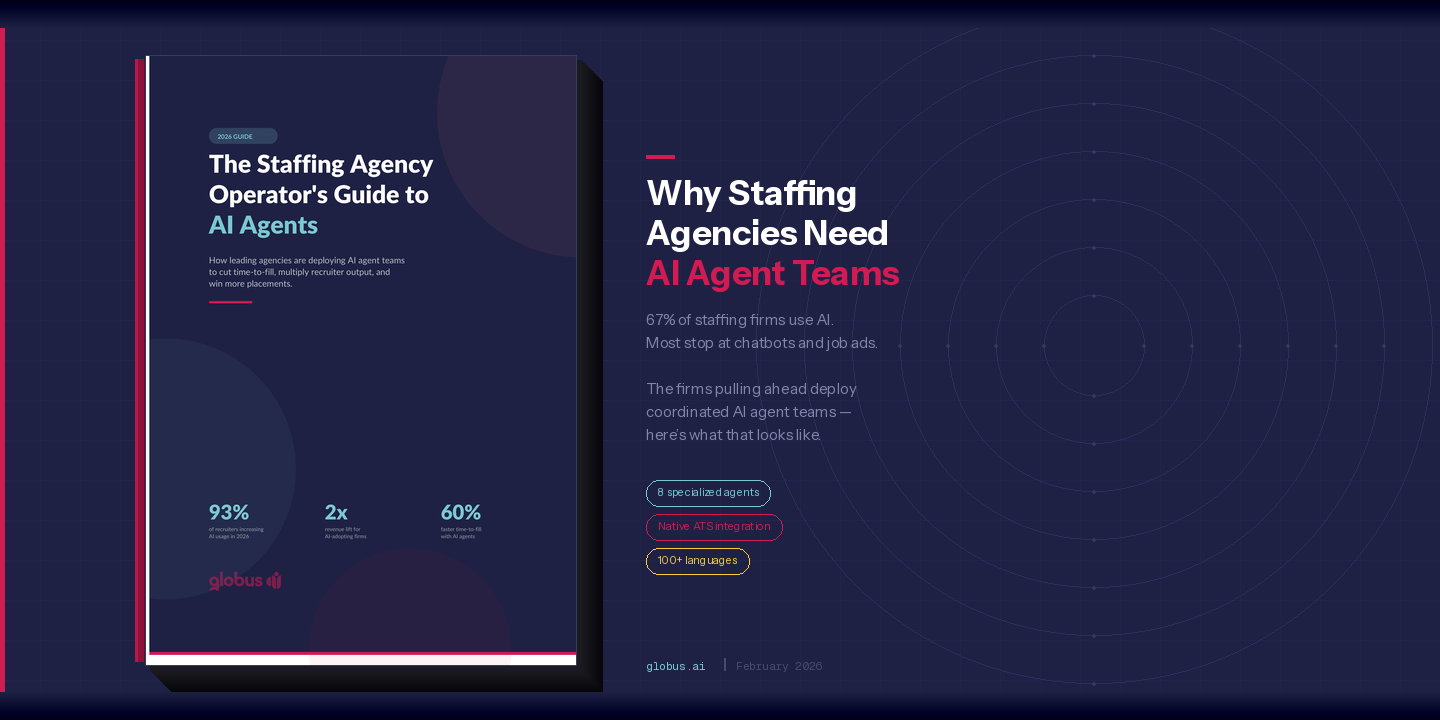
Why Staffing Agencies Need AI Agent Teams, Not Chatbots

67% of staffing firms use AI, but most stop at chatbots and job ads. The firms pulling ahead deploy coordinated AI agent teams — here's what that looks like and the results they're getting.
67% of Staffing Firms Use AI. Most Are Barely Scratching the Surface.
The statistic sounds impressive. Two-thirds of staffing agencies report using AI in their operations. But when you look at what "using AI" actually means for most of them, the picture gets a lot less exciting.
Writing better job descriptions. Cleaning up databases. Running a chatbot on the career page. Maybe some automated emails.
That's automation. It's useful. But it's not what's separating the leaders from everyone else right now.
The Shift: From Tools to Teammates
The agencies that are pulling ahead in 2026 have made a different bet entirely. Instead of using AI as a faster typewriter, they're deploying AI agent teams — coordinated groups of specialized agents that handle entire workflows from start to finish.
Not one chatbot answering FAQs. Not one feature bolted onto their ATS. A team of AI specialists, each responsible for a specific function in the staffing operation: order processing, candidate matching, engagement, compliance, screening.
The distinction matters because it changes what's possible.
A chatbot answers questions. An agent team receives a client order, parses it in seconds, matches it against the entire candidate database, reaches out to the best candidates via SMS and WhatsApp, confirms availability, checks compliance — and presents the recruiter with a ready-to-submit shortlist before they've finished their morning coffee.
What the Numbers Look Like
The early results from agencies running agent teams are hard to dismiss:
60% faster time-to-fill. When orders are parsed and candidates are matched in seconds instead of hours, the speed advantage compounds across every step.
2x roles per recruiter. Not by working harder — by eliminating the 14+ hours per week that Bullhorn research shows recruiters spend on manual sourcing and admin.
Under 2 minutes from order to first candidate contact. One Nordic education staffing agency went from hours of inbox processing to a 1.5-minute average response time, with a 93.6% offer acceptance rate.
24/7 coverage. Over 23% of placements happen outside office hours. Agent teams don't clock out.
These aren't projections. These are numbers from agencies already running this model.
The Three-Layer Agent Model
The most effective deployments we've seen follow a three-layer architecture:
Foundation: Data enrichment and orchestration. Before you automate workflows, you need clean data and a human-oversight dashboard. This turns your ATS from a data graveyard into a living, searchable asset.
Core Automation: Order intelligence, search and match, candidate engagement. This is where the revenue impact hits — orders processed in seconds, candidates contacted automatically, recruiters freed to focus on relationships and complex placements.
Quality and Compliance: Screening, intake, and credential monitoring. Every placement is quality-checked. Credentials are tracked in real-time. No recruiter manually manages compliance spreadsheets.
Each layer builds on the one below it. You don't deploy everything at once — you roll out in phases, measuring impact at each stage.
Why This Matters Now
The pace of improvement in AI models has accelerated sharply in the last few months. Tasks that needed constant human guidance six months ago now run autonomously with minimal oversight. The gap between what most people think AI can do and what it actually does today is enormous — and it's widening every month.
For staffing agencies, the window of competitive advantage is open right now. The firms that deploy agent teams this year will compound their operational efficiency gains while competitors are still debating whether to upgrade their chatbot.
The investment math is straightforward: an AI agent costs roughly $2,000–5,000 per year. A recruiter costs $50,000–80,000. An agent team doesn't replace recruiters — it multiplies them. Fifty recruiters supported by AI agents produce the output of seventy-five, without the hiring, onboarding, or management overhead.
The Full Playbook
We put together a comprehensive guide for staffing agencies that want to move from AI curiosity to AI deployment.
The Staffing Agency Operator's Guide to AI Agents →
Eight chapters covering the agent team model, five workflows with real metrics from production deployments, the ROI math, a phased implementation playbook, and a competitive landscape overview of what Bullhorn, Paradox, Job&Talent, KIKU, Randstad, and ManpowerGroup are building.
No email gate. No sales pitch. Just the guide.
If you run a staffing agency and want to see what an AI agent team could look like for your operation — we're happy to walk you through it.
Helge is CEO of Globus.ai, an AI platform for staffing and recruitment. Globus deploys named AI agents — Eira, Saga, Nora, Arne, and more — that work alongside recruiters across the Nordics and UK.